Intarsia, jacquard and fair isle: what the difference really is
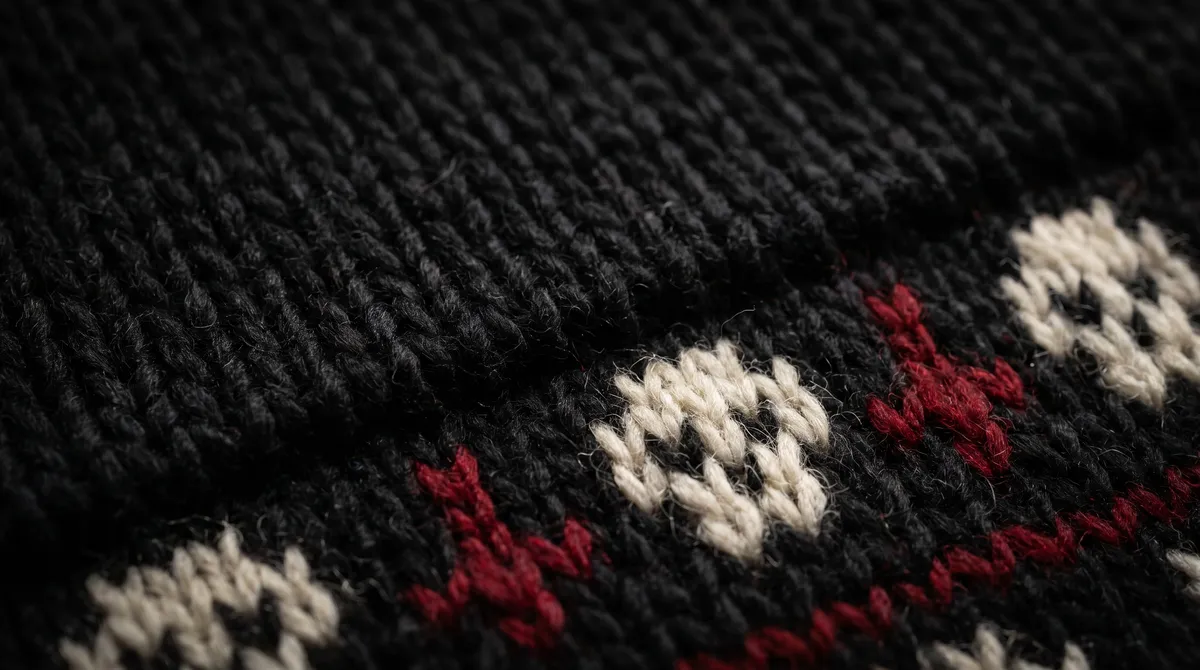
Every colourwork technique in knitting is an answer to the same problem. You are working a row, you need bone-white here and black there, and at any given stitch one of the two yarns is not in use. What happens to the one you are not using is the entire distinction between intarsia, jacquard and fair isle.
Fair isle: carried, in bands, two at a time
Fair isle comes from the Shetland islands and describes a tradition as much as a technique: small repeating motifs worked in horizontal bands, classically two colours in any single row. The unused colour is carried along the back of the work in short floats, picked up again a few stitches later.
Two colours per row and short floats are not arbitrary rules, they are what makes the fabric behave. Floats are strands lying loose on the inside; keep them short and they disappear into the fabric, let them run too far and fingers catch in them when the garment is pulled on. The banded look of traditional fair isle exists partly because the technique is happiest that way.
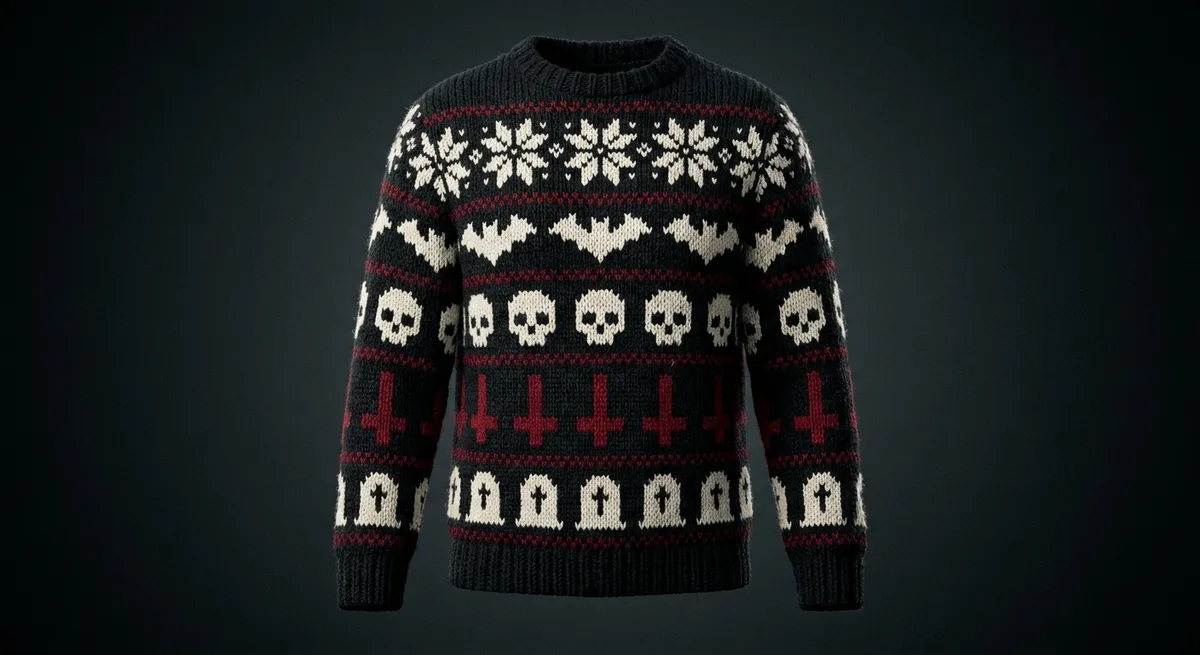
The result is a dense, warm, slightly springy fabric with an even texture, and it is the direct ancestor of every festive jumper ever made. When we band tombstones and bats around a chest instead of snowflakes and reindeer, the construction underneath is exactly the one from Shetland.
Jacquard: carried, any pattern, machine-driven
Jacquard is the general case. The machine reads a chart and decides for every stitch which colour shows on the face; the others are carried behind. It is not limited to bands, not limited to two colours per row, and not limited to motifs that repeat.
That freedom is why a full portrait is possible. A Gorgon with a crown of snakes has no repeat at all, spans most of the front, and needs three colours in the same row. No hand technique built around short floats gets you there in a garment you can wear.
The cost is on the inside: a wide area of one colour means a long float behind it. Well-made jacquard manages this by catching the floats into the fabric at intervals, which is why the back of a good one looks orderly rather than like a nest.
Intarsia: not carried at all
Intarsia is the odd one out, because the unused yarn does not travel. Each block of colour gets its own supply, and where two blocks meet the yarns are twisted around each other to lock the join. There are no floats behind the work, so the back is almost as clean as the front and the fabric stays a single thickness.
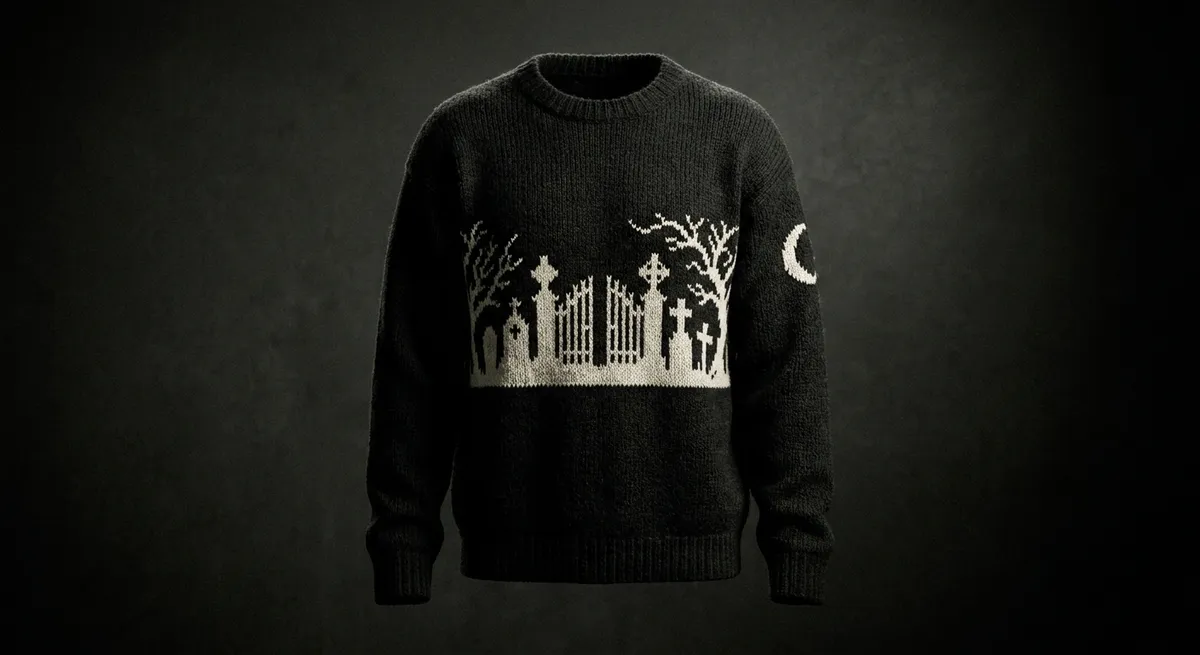
That makes intarsia the right answer for large, solid, non-repeating shapes: an argyle diamond, a single big graphic, a block of a second colour on one sleeve. It is the wrong answer for a small motif scattered across a whole garment, because every isolated shape needs its own yarn supply and the number of ends to manage becomes absurd.
The word comes from woodworking, from inlay, and it is a good description: the colours are set into the fabric rather than laid over it.
How to tell which one you are holding
Turn it inside out. Floats running horizontally across the back mean fair isle or jacquard. A back that is nearly as clean as the front means intarsia.
Look at the pattern itself. Small motifs in horizontal bands, two colours at a time, points at fair isle. A large non-repeating picture points at jacquard or intarsia.
Feel the thickness through the motif. Carried techniques make the patterned area double thickness. Intarsia does not, so the fabric weight stays even across the whole garment.
Which one is better
None of them, and anyone who tells you otherwise is selling one. They are tools with different jobs, and a single garment often uses more than one: banded jacquard through the body, intarsia for a large block, fair isle logic at the hem.
What matters for a buyer is simpler than the vocabulary. All three make the pattern out of yarn, and all three therefore outlive any print. The technique decides what the design can be. The fact that it is knitted at all decides how long it lasts.
The pieces in this story
More from the Journal
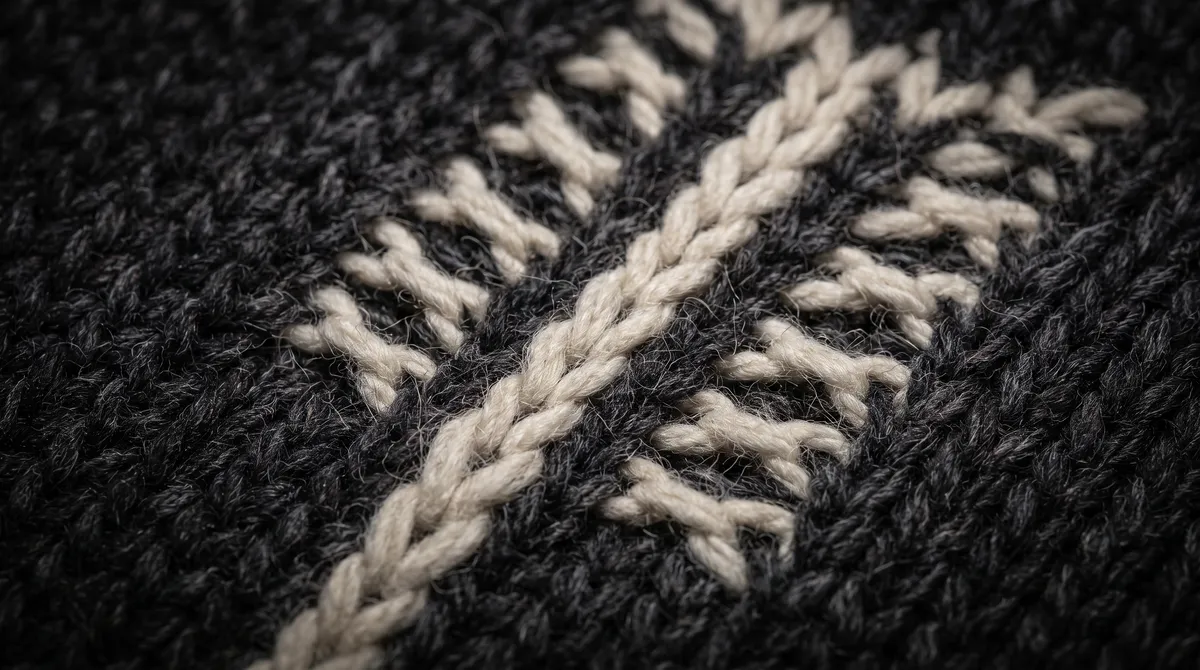
How to wash a wool sweater without ruining it
Cold water, no agitation, dry flat. The three rules that keep a heavyweight knit alive, and the one mistake that kills it in a single cycle.
What is jacquard knit, and why it beats a print
In a jacquard sweater the pattern is not on the fabric, it is the fabric. Here is how it is made and how to spot one in three seconds.
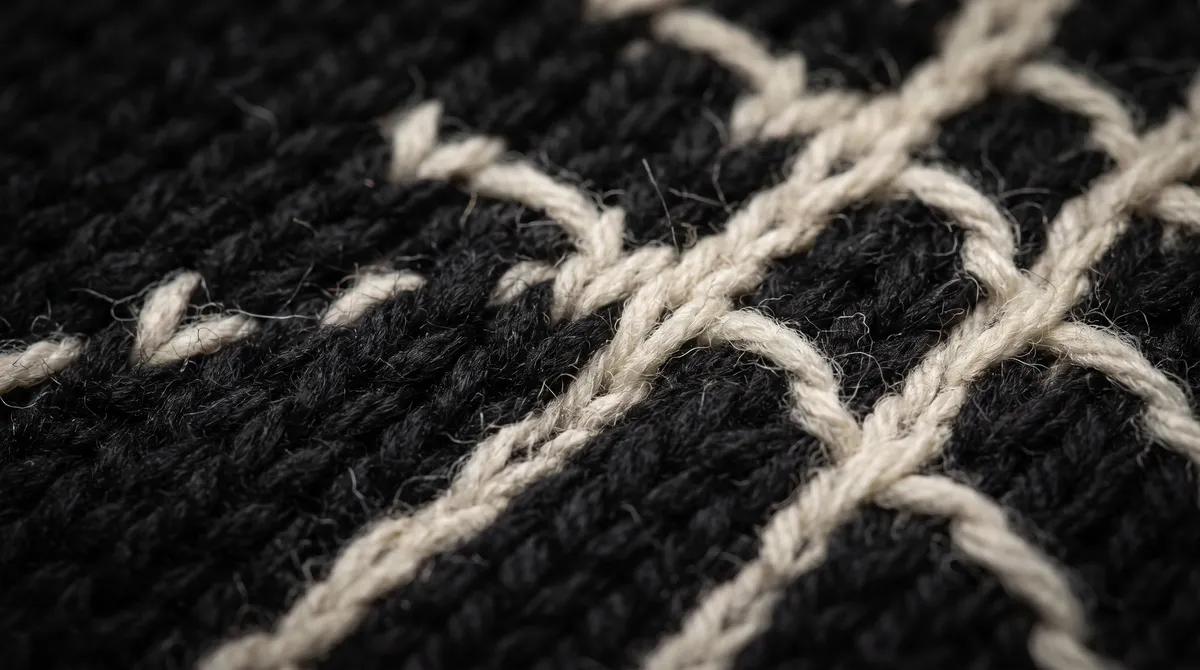
Why sweaters pill, and how to actually fix it
Pilling is friction, not quality. Here is what is actually happening on the surface of the fabric and the two minutes it takes to undo.
Knitted, never printed
Every motif is jacquard worked into the fabric on flat-bed machines. Nothing to crack, nothing to peel.
Made to order in Italy
Your piece does not exist until you order it: knitted, hand-finished and steamed in 2 to 3 weeks.
Free worldwide shipping
Tracked and free everywhere, with free size exchanges and 14 day returns.